

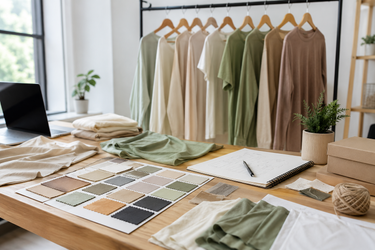
How to Source Sustainable Clothing for Boutique and Private Label Brands
For boutique and private label brands, sustainable clothing sourcing should begin with three questions: what materials can support your sustainability claims, which manufacturer can consistently meet your quality requirements, and whether the supplier can scale with your business. Rather than choosing a factory based only on certifications or the lowest quotation, brands should evaluate material traceability, manufacturing capabilities, sampling, quality control, communication, minimum order quantities, and long-term reliability.
This approach is especially important for smaller brands. The OECD notes that garment supply chains are highly fragmented and can involve multiple tiers of suppliers, making environmental, labor, and traceability risks harder to identify. Its due-diligence framework therefore encourages businesses to assess risks throughout the supply chain rather than relying on a single supplier credential.
How Boutique and Private Label Brands Source Sustainable Clothing
Effective clothing sourcing usually follows a staged process rather than starting with a factory quotation. Boutique owners and private label teams first define their product concept, target customer, fabric requirements, expected order volume, price range, and market. These details make it easier to identify a sustainable clothing supplier that actually fits the project.
A practical sourcing process can include:
- Define the product brief: Specify garment type, fabric composition, target GSM, colors, sizes, construction details, packaging, and expected annual volume.
- Shortlist manufacturers: Compare private label clothing manufacturers according to their materials, customization capabilities, MOQ, lead times, and quality systems.
- Verify material claims: Ask for current certificates, scope information, transaction documentation where applicable, and details about the fiber's supply chain.
- Request samples: Evaluate fabric hand feel, shrinkage, color consistency, stitching, fit, finishing, and packaging before discussing a larger production run. Compare total sourcing costs: Consider sampling, customization, packaging, freight, duties, and potential rework rather than comparing unit prices alone.
Material selection deserves particular attention. Bamboo, organic cotton, Modal, Ecocosy, and Lyocell are among the materials offered through Ecoenfam's fabric program, giving brands several options for different product positioning and performance requirements.
For organic fibers, certification should also be interpreted carefully. Textile Exchange explains that standards such as the Organic Content Standard (OCS) use chain-of-custody systems to track organic material through the supply chain. A certification therefore provides useful evidence, but brands still need to verify what exactly is certified and whether the certification applies to the finished product they intend to sell.
How to Evaluate a Custom Clothing Manufacturer Beyond Certifications
Certifications are useful screening tools, but they do not tell you everything about a manufacturer's ability to produce your collection. A factory may have access to certified fabrics while still being unsuitable for a boutique brand because of high MOQs, weak communication, inconsistent workmanship, or limited customization.
A better evaluation looks at the complete manufacturing process. Start with the manufacturer's actual experience in your product category. If you are developing bamboo pajamas, for example, ask whether the factory regularly handles soft knitted fabrics, elastic waistbands, printed labels, matching sets, and other details relevant to sleepwear.
Then assess operational capabilities. A suitable clothing manufacturer for startups should be able to explain how it handles sampling, revisions, production scheduling, inspections, packaging, and shipment. Smaller brands often need more flexibility than established retailers because designs may change after customer testing or initial sales.
Ecoenfam, for example, presents its manufacturing service as a combination of design support, production, packaging, logistics, and customs coordination. Its website also states that brands can select base styles and customize fabrics, colors, sizing, and craftsmanship details.
Quality control should be evaluated in practical terms. Ask how fabric defects are identified, how measurements are checked, what happens when a production sample differs from the approved sample, and whether inspection records can be provided. These details often reveal more about manufacturing reliability than a certification logo alone.
The same principle applies to sustainability. OECD research published in 2025 emphasizes that certifications can support due diligence but should be considered as part of a broader assessment rather than a substitute for it.
Questions to Ask Before Requesting Samples, MOQ and Quotations
Before requesting samples or a quotation from a sustainable clothing supplier, prepare a clear list of questions. This reduces back-and-forth communication and makes supplier comparisons more meaningful.
For clothing sourcing, ask about the following areas:
| Area | Questions to Ask |
| Materials | What fabrics are available? What certifications or traceability documents can be provided? |
| Customization | Can the manufacturer modify fabric, color, sizing, labels, trims, and packaging? |
| Samples | How long does sampling take? How many revisions are included? |
| MOQ | Is the MOQ calculated per style, color, size, or total order? |
| Production | What is the standard bulk lead time after sample approval? |
| Quality | What inspections are performed before shipment? |
| Packaging | Can branded labels, hangtags, bags, and customized packaging be produced? |
| Shipping | What shipping methods and delivery terms are available? |
MOQ deserves special attention for boutiques and startups. A low unit price is not necessarily attractive if the required order quantity creates excessive inventory risk. A flexible clothing manufacturer for startups may therefore be more valuable than a factory offering the cheapest price at a very high volume.
Ecoenfam currently promotes a low-MOQ model starting from 100 pieces and states that samples can generally be developed within 7–15 days, while bulk production is presented at around four weeks. Its OEM/ODM service also highlights rapid prototyping, design support, quality control, and customized styles. Actual timing should still be confirmed for each project because fabric availability, construction complexity, and order volume can affect production schedules.
When comparing quotations from private label clothing manufacturers, make sure every supplier is pricing the same specification. A quotation based on a different fabric composition, lower GSM, simpler packaging, or fewer finishing details is not directly comparable.
Building Long-Term Partnerships with Sustainable Clothing Manufacturers
Successful sustainable clothing sourcing does not end when the first purchase order is delivered. For boutique brands, the manufacturer becomes part of the product-development process. A reliable partner can help refine fabric choices, identify production limitations, improve samples, and maintain consistency as collections expand.
This is particularly relevant because apparel supply chains are often multi-tiered. OECD guidance notes that brands may have limited visibility beyond their direct suppliers, while subcontracting and indirect sourcing can make risk management more difficult.
Long-term cooperation should therefore be based on documented expectations. Brands can establish approved fabric specifications, measurement tolerances, color standards, packaging requirements, inspection procedures, and communication schedules. Maintaining these records makes repeat orders easier and reduces the risk of gradual changes in materials or workmanship.
The relationship should also allow constructive discussion about sustainability. Instead of asking a supplier simply to “be sustainable,” brands can work together on specific objectives such as increasing certified material usage, improving packaging, reducing unnecessary components, or selecting fabrics that better match the intended product lifecycle.
Long-term partnerships can benefit both sides. Recent OECD research highlights strategic supplier relationships as an increasingly important approach for improving information flows and coordinated risk management in apparel supply chains.
Conslusion
For brands evaluating private label clothing manufacturers, the strongest partnership is therefore not necessarily the largest factory or the lowest-cost supplier. It is a manufacturer that understands the brand's product requirements, communicates clearly, provides evidence for sustainability claims, maintains consistent quality, and can adapt as order volumes and collections change.
For boutiques looking for a combination of sustainable fabrics, private label customization, and relatively flexible production volumes, Ecoenfam offers bamboo, organic cotton, Modal, Ecocosy, and Lyocell options alongside OEM/ODM and private label manufacturing services, making it worth considering as part of a broader supplier shortlist.
It is possible that you also want to know:
How Fashion Brands Develop Sustainable Clothing Collections
Organic Cotton Clothing Manufacturers: How to Choose
Zhuhai Enzhuo Clothing Co., Ltd.

Contact: Yinger (General Manager)
@ 2026 Ecoenfam Apparel